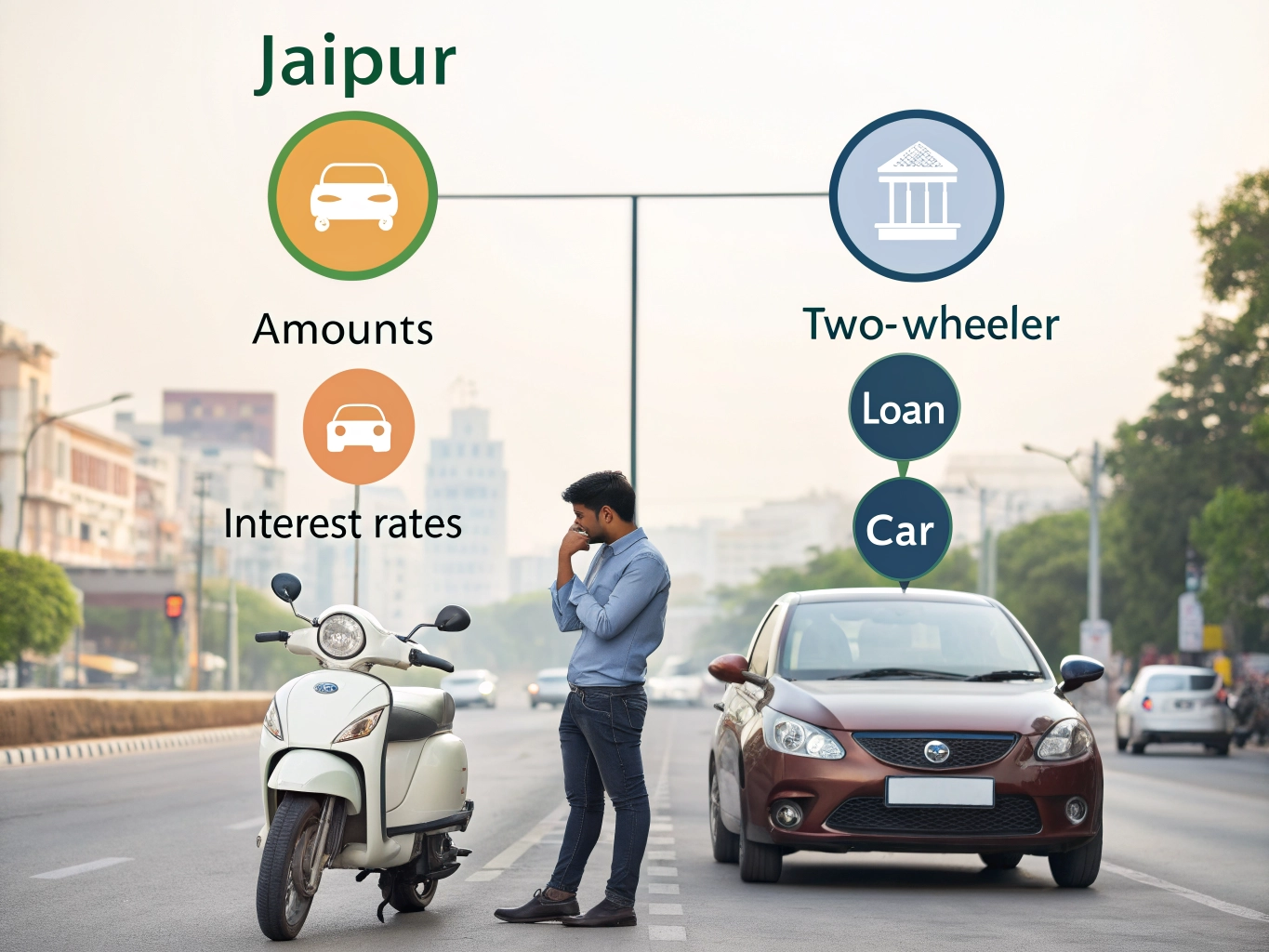
A new car loan costs less to borrow but more to buy. An old car loan costs less upfront but more to finance. That tradeoff is the entire comparison in one line, and everything else, interest rate, LTV, tenure, total cost, flows from it.
In 2026, new car loan rates in India start from 8.5 percent and used car loan rates start from 9.5 percent. That 1 to 3 percentage point gap sounds small. On a ₹8 lakh loan over 5 years, it adds up to ₹25,000 to ₹45,000 in extra interest paid. For a Jaipur buyer choosing between a brand new hatchback and a 3-year-old sedan in the same price range, understanding this gap properly changes the decision.
At Anantaa Finance, a Jaipur-based loan advisory that compares vehicle loan offers across lenders, this is the comparison we run for buyers almost every week. New versus used is rarely a clear-cut answer. It depends on the car’s age, your down payment, your CIBIL score, and how long you plan to keep the vehicle.
Why Used Car Loans Cost More to Finance
Lenders treat new and used car loans as different risk categories. The reason is straightforward.
A new car has a predictable value. It comes with a manufacturer’s warranty, a fixed on-road price, and a standard depreciation curve. If a borrower defaults, the lender recovers against a known asset.
A used car is harder to value and harder to recover. Its condition depends on how the previous owner treated it. Its market value varies based on age, mileage, service history, and demand for that specific model. Lenders price that uncertainty into a higher interest rate.
The difference in 2026 typically runs from 1.5 to 3 percentage points. SBI charges 8.75 to 9.25 percent for new car loans and 10.25 to 11.50 percent for used car loans on comparable profiles. Private banks and NBFCs follow a similar spread.
Loan-to-Value Ratio: The Bigger Difference
Interest rate is not the only number that changes. The loan-to-value ratio, how much of the car’s price the lender will finance, changes significantly too.
For new cars, many lenders offer up to 85 to 100 percent financing on the on-road price. Strong CIBIL scores and specific lender promotions can push this to the full amount.
For used cars, lenders finance 70 to 80 percent of their own valuation of the vehicle. Not the price you agreed to pay the seller. The lender sends a technical evaluator who assesses the car’s actual market value, and the loan is calculated on that number.
This matters in Jaipur’s used car market. Say you find a 4-year-old car at a dealer near Sindhi Camp or through a private seller in Vaishali Nagar, priced at ₹6 lakh. The lender’s evaluator values it at ₹5.2 lakh. At 75 percent LTV on that valuation, you get ₹3.9 lakh as the loan. You need to arrange ₹2.1 lakh yourself, not ₹1.2 lakh as you originally calculated. That surprise is very common and worth planning for.
Tenure Differences
New car loans go up to 7 years in 2026 from most major lenders. Used car loans are capped shorter.
The constraint on used car tenure is the vehicle’s age. Most banks will not extend a loan if the car will be older than 10 years at the time of the final EMI. So a 5-year-old car today can get a maximum tenure of 4 to 5 years. A 7-year-old car might get only 2 to 3 years.
Shorter tenure on a used car means higher EMI for the same loan amount. Combined with the higher interest rate, the monthly outgo on a used car loan can be surprisingly close to, or sometimes higher than, a new car loan EMI for a similar amount.
The Total Cost Comparison: A Jaipur Example
Priya is considering two options. A new hatchback priced at ₹8 lakh on-road, or a 3-year-old sedan priced at ₹7 lakh.
New car:
- Loan amount: ₹7.2 lakh (90 percent LTV)
- Rate: 9 percent
- Tenure: 60 months
- Monthly EMI: approximately ₹14,950
- Total interest paid: approximately ₹1.77 lakh
Used car:
- Lender values it at ₹6.2 lakh
- Loan amount: ₹4.65 lakh (75 percent of valuation)
- Down payment needed from Priya: ₹2.35 lakh
- Rate: 11.5 percent
- Tenure: 48 months (car is 3 years old, tenure limited)
- Monthly EMI: approximately ₹12,100
- Total interest paid: approximately ₹1.16 lakh
EMI looks lower on the used car. Total interest is lower too. But Priya needs ₹2.35 lakh upfront for the used car versus ₹80,000 for the new one. If she does not have that cash readily available, the used car option stops working regardless of the lower EMI.
This is the calculation most buyers skip. At Anantaa Finance, we run this comparison for Jaipur clients before they commit to either option, because the right answer almost always depends on how much down payment is available, not just which EMI looks lower on paper.
What Changes Based on the Car’s Age
Not all used cars are treated the same. Lenders apply different criteria based on how old the vehicle is.
| Car age | Typical LTV | Typical max tenure | Rate premium over new |
|---|---|---|---|
| 1 to 3 years old | 75 to 80 percent | 5 years | 1 to 1.5 percent |
| 3 to 5 years old | 70 to 75 percent | 3 to 4 years | 1.5 to 2.5 percent |
| 5 to 7 years old | 60 to 70 percent | 2 to 3 years | 2 to 3 percent |
| Above 7 years | Very few lenders | 1 to 2 years | 3 percent or more |
A car above 10 years old at loan maturity is not financeable by most mainstream banks in Jaipur. Some NBFCs go higher, but at rates that make the loan expensive enough to question whether financing makes sense at all.
Buying From a Dealer vs a Private Seller
This affects your loan terms directly. Banks and HFCs are more comfortable financing used cars bought through organised dealers like Maruti True Value, Hyundai H Promise, or Toyota U Trust, compared to private party transactions.
Dealer-sourced used cars come with inspection certification and cleaner paperwork. Lenders offer slightly better LTV and sometimes lower rates for these compared to private purchases. If you are buying used in Jaipur, whether from a dealer in Tonk Road’s pre-owned car market or through a private listing, clarify with the lender upfront whether the source affects your terms.
You can verify current vehicle loan rates and lender lists through the RBI’s regulated entity portal before committing to any lender, particularly for used car financing where NBFC involvement is more common.
Prepayment: One Key Difference to Know
Car loans in India are almost always fixed-rate. RBI’s zero prepayment penalty rule applies only to floating-rate loans. Fixed-rate vehicle loans typically carry a prepayment charge of 2 to 5 percent of the outstanding principal.
This matters more for used car buyers who may want to close the loan faster given the shorter tenure and higher rate. Check the prepayment clause in the sanction letter before signing, since this charge can eat into the interest savings from early closure.
If you want to compare new versus used car loan offers from multiple lenders based on your exact profile in Jaipur, Anantaa Finance’s vehicle loan advisory can map out the real numbers before you walk into any showroom or dealer.
Talk to us on WhatsApp and we will tell you which option actually works better for your down payment, income, and the specific car you have in mind.
Frequently Asked Questions
1. Is it cheaper to finance a new car or a used car in Jaipur? A used car costs less to purchase, but the loan costs more. Used car loan rates in 2026 typically run 1.5 to 3 percentage points higher than new car loans, with shorter tenures and lower LTV ratios. Whether the total cost is lower depends on the down payment you can arrange and the specific car’s age and valuation.
2. How much down payment do I need for a used car loan in Jaipur? Most lenders finance 70 to 80 percent of their own valuation of the car, not the price you agreed to pay. Budget for at least 20 to 30 percent of the lender’s valuation as your down payment, plus the gap between the seller’s asking price and the lender’s valuation if those differ.
3. What is the maximum age of a used car that can be financed? Most banks require the car to be no older than 10 years at the time the final EMI is paid. So a car that is already 7 years old can get a maximum tenure of 2 to 3 years. Some NBFCs go beyond 10 years but at higher rates and stricter conditions.
4. Can I get a 100 percent loan on a new car in Jaipur? Some lenders offer up to 100 percent financing on the on-road price for new cars, subject to a strong CIBIL score and income profile. However, financing the full amount means higher EMI, more total interest, and no equity in the car during the initial months. A down payment of 15 to 20 percent is generally recommended.
5. Do car loan interest rates change based on my CIBIL score? Yes, significantly. A 100-point drop in CIBIL score typically adds 0.75 to 1.25 percent to your interest rate. On a ₹10 lakh loan over 5 years, that translates to ₹28,000 to ₹46,000 in extra interest paid. Improving your score before applying is almost always worth the wait.